
Basket Empty
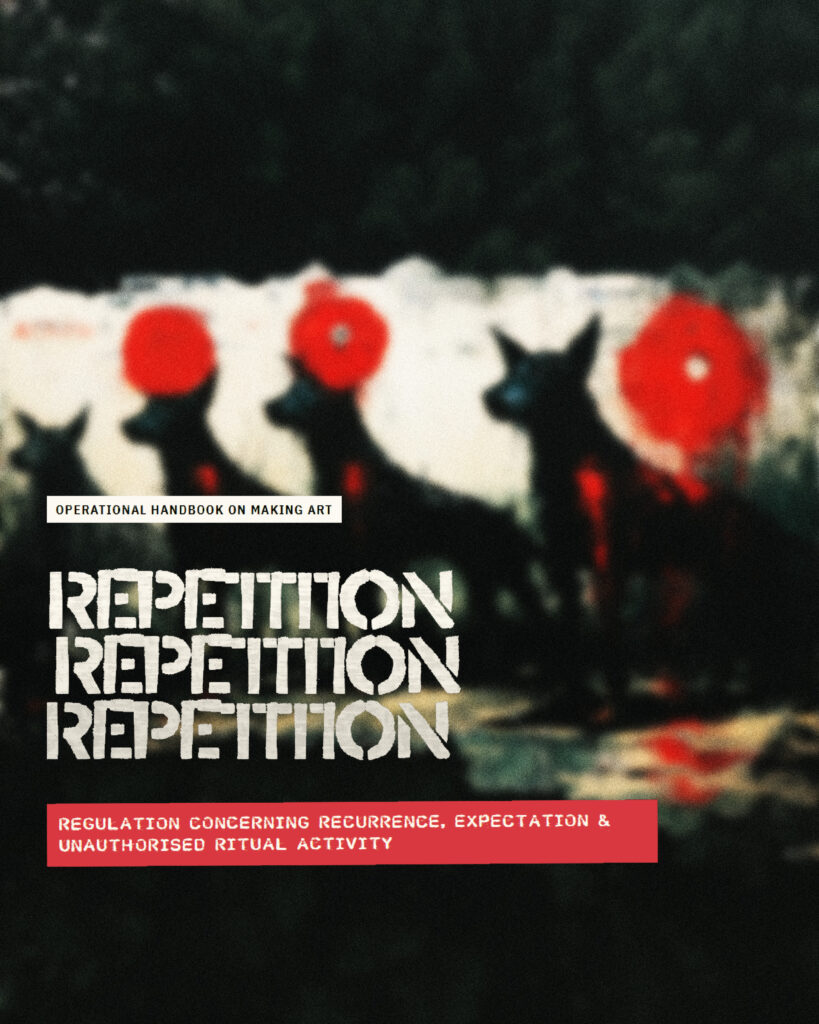
Ashmouth Assembly / Field Manual 04 of 11
Department of Recurring Incidents / Regulation 04Pattern active / controlled copy
Operational Handbook on Making Art
RepetitionRepetitionRepetition
Regulation Concerning Recurrence, Expectation & Unauthorised Ritual Activity
- Document04
- Recurrent materialConfirmed
- Pattern statusActive
- Dog statusReturned
Incident update 04/R / returned material
In the previous document, the dog escaped.
It has now returned.
This changes the classification.
ONE APPEARANCE IS AN INCIDENT.
THREE APPEARANCES MAY INDICATE A PATTERN.
TEN APPEARANCES CONSTITUTE LOCAL FOLKLORE.
A shape.
A phrase.
A colour.
A face.
A noise.
A dog that apparently has nowhere else to be.
The first appearance introduces it.
The second makes the first one suspicious.
By the third, somebody may begin asking questions.
Good.
DO IT AGAIN.
There is a great deal of pressure to keep moving.
New image.
New idea.
New project.
New direction.
New version of yourself announced before the previous one has finished drying.
The feed likes repetition too.
It just prefers it dressed as novelty.
The same format with a different face.
The same hook with a new caption.
The same thing again, presented as the next thing.
None of this tells you whether the idea has finished.
Artists often abandon something just as it begins to acquire weight.
They use an image once, decide it has been done, then rush off looking for another one.
Wasteful.
People may barely have noticed.
They may have assumed the dog was an accident.
Bring it back.
Not because you have run out of ideas.
Because the idea has not finished causing trouble.
DO NOT CONFUSE MOVING ON WITH MOVING FORWARD.
Repetition does things.
A chant gets louder because it returns.
A drum machine becomes hypnotic because it refuses to apologise.
A poster seen once is a poster.
The same mark appearing across a town begins to suggest that somebody is up to something.
Sometimes repetition should be exact.
A stamp does not need character development.
Sometimes the returning thing changes.
Larger.
Smaller.
More damaged.
Less obvious.
Moved from the edge to the centre.
Put somewhere it should not be.
The important thing is not that every appearance is identical.
The important thing is that the return can still be recognised.
IT HAS BEEN HERE BEFORE.
The new appearance is no longer alone.
It arrives carrying the others with it.
ASHMOUTH ASSEMBLY NOTICE 04/A
RECURRENT MATERIAL: DETECTED.
SECOND APPEARANCE: COINCIDENCE UNCONFIRMED.
THIRD APPEARANCE: FILE OPENED.
PUBLIC EXPECTATION: FORMING WITHOUT AUTHORISATION.
MEANING: ACCUMULATING.
DOG: RETURNED TO AREA.
EXPLANATION: NOT CURRENTLY REQUIRED.
A mark used once is a mark.
Bring it back and a relationship appears.
Bring it back again and people begin to suspect intention.
After that, the thing starts collecting associations.
The first dog may be lonely.
The next may be watching.
The third may be standing somewhere a dog has no legitimate reason to be.
Soon it is no longer merely a dog.
It has a record.
People begin constructing meaning across the appearances.
Some of that meaning will be yours.
Some of it will not.
Excellent.
The recurring thing has started doing work between the works.
REPETITION MAKES MEMORY HEAVIER.
At some point people stop saying:
“There’s a dog.”
They begin saying:
“The dog’s back.”
Later:
“I was wondering when the dog would turn up.”
They are no longer encountering an isolated thing.
They are encountering a return.
And a return carries history.
A recurring thing does not automatically become interesting.
Putting the same red circle in the corner every time may eventually produce a large quantity of red circles.
Congratulations.
The stationery department is delighted.
Recurrence is not decoration.
The element comes back, but something around it changes.
The red circle might begin as a warning.
Later it looks like an eye.
Later still, a target.
Then a hole.
Then one day it is absent and the empty space where it should have been becomes suspicious.
Now we have a situation.
THE RETURN MUST HAVE CONSEQUENCES.
Its context can change.
Its job can change.
Its meaning can become less stable rather than more.
Good.
The recurring element does not need a dictionary definition.
It needs history.
Power understands repetition perfectly well.
It prints the same logo until the logo feels inevitable.
It repeats the same instruction until the instruction starts sounding like common sense.
The same slogan appears behind every podium.
The same warning appears on every wall.
Eventually you stop noticing that somebody put it there.
Do not surrender the machinery.
A slogan repeated by a crowd becomes larger than the sentence.
A symbol appearing across a town begins to look like evidence of an organisation, even when the organisation consists of two people, one marker pen and a disagreement about lunch.
A mark appearing once may be decoration.
A mark that keeps appearing where nobody authorised it begins to look like a transmission.
Repetition occupies space.
It makes a claim.
THIS HAS NOT GONE AWAY.
That can be irritating.
Useful things often are.
Novelty Has Left the Building.
There is a point where repetition becomes boring.
Good.
Novelty has left the building.
Now you find out what the thing can actually do.
Repetition can be work.
Dull, mechanical, stubborn work.
The same mark.
The same beat.
The same phrase.
Another pass.
The railings are repainted.
The paint flakes off.
The railings are repainted.
The paint flakes off.
The procedure remains under review.
A loom does not demand a fresh concept before the next cycle.
Sometimes doing the thing again is how it gains weight.
Sometimes boredom becomes rhythm.
Rhythm becomes insistence.
Insistence becomes expectation.
There is also a point where it merely becomes tedious.
Ashmouth has so far failed to establish where one becomes the other.
You will have to use judgement.
Remember that you are standing much closer to the thing than everybody else.
You have lived with it in sketches, drafts, test prints and the corner of your screen at two in the morning.
The audience may have seen it once while looking for their glasses.
YOUR BOREDOM IS NOT YET A CULTURAL EVENT.
Is the return gaining pressure?
Would its absence now be noticeable?
If yes, continue.
If no, it may have completed its service.
Give it a small pension.
Not everything deserves mythology.
Some things should happen once and then be quietly buried behind the shed.
Ritual Forms Without Authorisation.
Eventually recurrence acquires expectation.
That is where ritual begins.
The gesture no longer feels accidental.
It belongs to the event.
People know it is coming.
Or they notice when it does not come.
A phrase becomes a call.
A shape becomes a sign.
A character becomes a witness.
A noise becomes an arrival.
An ordinary act becomes something people wait for.
Every Thursday somebody moves the same table in the same pub to approximately the same wrong place.
Somebody else moves it back.
This has been happening for years.
No minutes are available.
Nobody needs to officially declare that a ritual has formed.
Please do not hold a launch event for the ritual.
That will make everybody uncomfortable.
Let it establish itself through use.
One day somebody will refer to it as though it has always been there.
The paperwork can be falsified afterwards.
And then there is the dangerous bit.
People start adding things.
They misunderstand it.
They copy it.
They rename it.
They invent explanations.
They remember an appearance that never actually happened.
Someone insists their uncle saw one behind the old mill in 1987.
You have no uncle fitting this description.
It does not matter.
The thing has begun acquiring folklore.
A recurring image can accumulate meaning while it remains under the author's supervision.
Once it enters other people's memory, conversation, copying and invention, something else begins.
Control becomes unreliable.
Good.
You do not own every meaning it collects.
This is the price of letting things out.
MYTH IS WHAT HAPPENS WHEN THE FILE GETS OUT OF ORDER.
Ashmouth accepts no responsibility for contradictory witness statements.
Field operation / recurrence test
OPERATION 04: ESTABLISH A MINOR RITUAL
05appearances
Return to the evidence from the previous operation.
Look at the things you found yourself doing anyway.
A shape.
A phrase.
A character.
A colour.
A particular mark.
An object, sound, gesture or bit of damage that kept turning up.
Choose one that has already appeared more than once, or something you have noticed yourself returning to.
Do not invent a special symbol because an instruction manual told you to.
That would be embarrassing for both of us.
Now give it five appearances.
This does not mean five finished artworks.
An appearance might be a sketch, a photograph, a phrase, a post, a sound, a test, a variation, an object or a mark inside something larger.
Some appearances can stay in the studio.
Some can be put where other people might encounter them.
Small things count.
The Assembly does not require five masterpieces before tea.
Keep enough of the thing intact that its return remains possible to recognise.
Change the circumstances.
Change its scale.
Change its context.
Give it a different job.
Put it somewhere unexpected.
Make one appearance easy to miss.
Make another unavoidable.
Do not simply make it louder each time so somebody passes the test.
That is not recurrence.
That is shouting.
The later appearance should not arrive alone.
Do not announce that you are conducting an experiment.
That contaminates the witnesses.
If an appearance enters public circulation, just put it there.
Do not explain the recurrence.
Let people encounter it before telling them what they are supposed to notice.
Then, if you have somebody reasonably familiar with the work, ask:
WHAT CAME BACK?
Do not explain the correct answer.
If they identify it, record the event.
If they do not, use judgement.
Perhaps they missed it.
Perhaps the connection is too weak.
Perhaps there have not been enough appearances yet.
Perhaps the thing is not worth repeating.
No scoring system will be provided.
Operation complete when
- THE ELEMENT HAS RETURNED.
- THE APPEARANCES DO NOT ALL HAVE THE SAME JOB.
- AT LEAST ONE LATER APPEARANCE CARRIES THE MEMORY OF AN EARLIER ONE.
Useful witness evidence may include:
“THAT AGAIN?”
No certificate will be issued.
RECORD OF ACTIVITY
Record what changed between appearances.
Record anything the later appearances seem to have inherited from the earlier ones.
If somebody notices, record what they said.
Comments, replies, messages and accidental recognition all count.
The important thing is that somebody recognised the recurrence without being prompted.
Useful statements include:
“I’ve seen that before.”
“Is that the same thing?”
“Why does this keep turning up?”
“What’s with the dog?”
The exact wording does not matter.
If nobody notices, do not immediately explain everything in a six-paragraph caption.
Look at the evidence.
Decide whether the thing needs another appearance, more time, or a quiet burial behind the shed.
If it still has work to do:
DO IT AGAIN.
Repetition is not proof that you have run out of ideas.
Sometimes it means you found one with more than one life.
Bring it back until it gains weight.
Bring it back until people recognise the return.
Bring it back until they start expecting it.
Bring it back until its absence becomes suspicious.
And if, eventually, people begin attaching stories to it that you never supplied:
Do not panic.
The operation may simply have succeeded.
REPETITION.
REPETITION.
REPETITION.
The first was an appearance.
Then a pattern.
Then an expectation.
After that, records become unreliable.